Five of Swords
hollow victory · conflict · ego · pick your battles
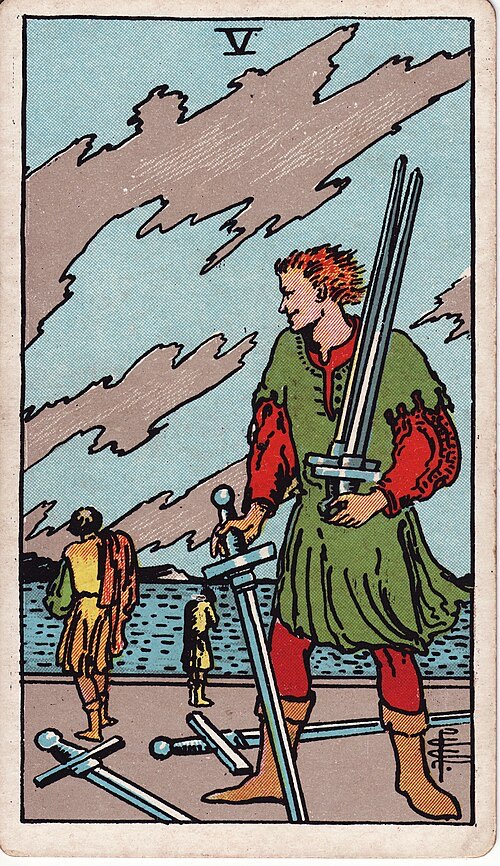
A man gathers swords from the ground, a smirk on his face, while two others walk away with their backs turned and their heads bowed. The sky behind them is torn and ragged. He has won — he holds the blades — and no one is celebrating, least of all, if he's honest, himself.
This is the anatomy of a hollow victory. Someone came out on top, and the cost was the room, the friendship, the good faith, the thing that mattered more than being right. The Five of Swords asks a question the winner rarely stops to hear: was it worth it?
Upright
You can win this fight — and the win will taste like ash. The Five of Swords is the conflict where victory and loss stop being opposites: you take the ground and lose the alliance, you prove the point and poison the well, you're right in a way that leaves you alone. Sometimes you're the one holding the swords; sometimes you're walking away defeated. Either way the card's counsel is the same — pick your battles. Not every hill is worth the body count, and some wars cost more to win than to concede. Ask what you're actually fighting for. If it's just to not lose, walk away from it. The strongest move on this card is often the one that declines the fight.
Reversed
A loosening. Reversed, the Five can mean you're ready to release a conflict you've been gripping — to make amends, to lay down the grudge, to stop re-fighting the war in your head. Or it can be the moment the true cost of a win finally lands: you got what you wanted and see now what it took, and regret arrives on schedule. Either way the smirk fades and honesty returns. Reversed asks you to choose reconciliation over being right one more time. Put the swords down. The fight was never worth what it charged you.
Across the four arenas
- Love — Winning the argument and losing the closeness. Point-scoring, the need to be right cutting the bond it should protect. Ask whether you want to win or want to stay. You rarely get both.
- Work & wealth — A victory that burns a bridge — the deal won badly, the colleague humiliated, the reputation nicked. Consider the war behind the battle. Some wins recruit tomorrow's enemies.
- Body — Tension carried from conflict, the clenched jaw of a fight you can't let go. The stress of needing to win taxes the body. Releasing the grudge is a physical relief.
- Mind — The signature arena. The ego mistaking domination for truth, the mind that must prevail at any price. Sharper thinking asks not can I win but should this be a fight at all.
How Sage reads it
Don't read the Five of Swords as simple triumph or simple defeat — that's the misread that keeps people fighting the wrong wars. Its deeper current is the price of winning: the ego's hunger to be right, weighed against everything that hunger tends to cost. The card's shadow is the man with the smirk, collecting blades in an empty field, mistaking the last one standing for the one who won. So Sage reads the Five as a question, not a verdict: is this battle yours to fight, and will the victory leave you richer or just alone? Choose fewer fights. Win the ones that matter. Walk away proud from the ones that don't.
Not every fight you can win is worth winning. Pick your battles — and walk away from the ones that only feed the ego.