The Hermit
solitude · introspection · inner guidance · wisdom
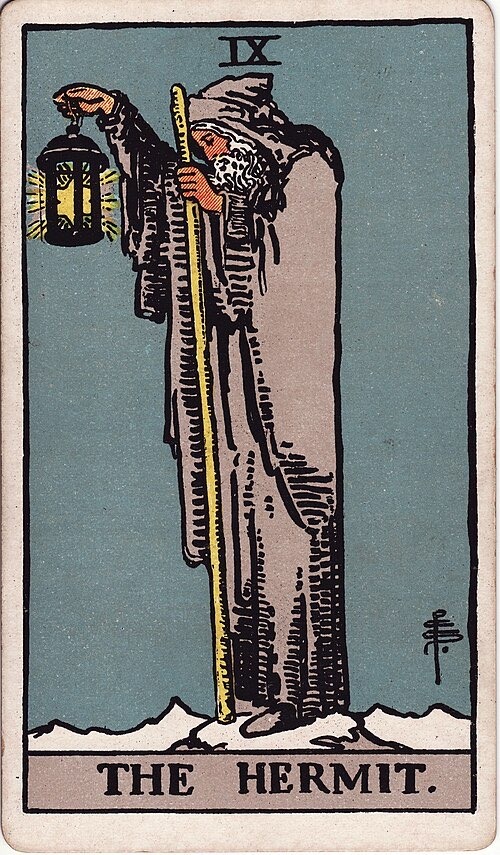
An old man stands alone on a snowy peak, a grey cloak against the cold, a staff in one hand for the slow ground. In the other he lifts a lantern — and inside the lantern, a six-pointed star. He has climbed above the noise of the valley to find a light small enough to trust. The lantern doesn't flood the mountain. It shows only the next few feet of path. That, the Hermit knows, is all a lantern is for.
Strength made peace with the inner beast; the Hermit withdraws to hear what the quieted self has to say. Number nine is the near-completion of a cycle, the pause before the wheel turns — a stepping-back that looks like retreat and is actually the deepest kind of navigation.
Upright
Withdraw from the noise. Not forever, not in bitterness — but deliberately, the way you'd climb above a loud valley to hear yourself think. The Hermit's whole counsel is that some answers only arrive in solitude, and the season is asking you to stop consuming other people's voices long enough to find your own. The lantern is the key image: it lights only what's directly in front of you, and that is enough. You don't need the whole path illuminated. You need the next honest step, and the willingness to walk it slowly. Rest, reflection, the internal audit before the next move — this quiet is not idleness. It's the work.
Reversed
The cave has stopped being sacred and started being a hiding place. Reversed, the Hermit is solitude curdled into isolation — withdrawal that began as renewal and hardened into avoidance, a refusal of the input and connection that would actually help. Sometimes it's the opposite complaint: too little solitude, a nervous system worn raw by noise, no lantern-time at all. And sometimes it's wisdom that never comes back down the mountain — overthinking without action, insight hoarded, a superiority that uses "the inner path" as a way to look down on ordinary life. The lantern was always meant to be carried back.
Across the four arenas
- Love — A natural phase of withdrawal that is renewal, not rejection. Say so plainly to the people who love you — the Hermit's retreat wounds when it's silent and heals when it's named. You'll return with more to give.
- Work & wealth — Step back to assess before the next move. This is a season for research, reflection, and honest internal audit, not for a bold public play. Don't rush this phase — the clarity you gain here is the real asset.
- Body — Rest and recovery as active practice. The body heals in solitude and stillness, and this is a moment to honor that rather than override it. Recovery is training too.
- Mind — Deep, solitary study. The Hermit reads the primary source, not the summary — goes deep rather than wide, sits with the hard text alone until it opens. Follow one thread all the way down.
How Sage reads it
People read the Hermit as anti-social — the recluse who's given up on people. That misses the lantern entirely. He carries a light, and a light is for showing the way, which means the whole point of his withdrawal is to find something worth bringing back. His solitude is an errand, not an exile. Its shadow is what happens when the errand is forgotten: isolation used to dodge vulnerability, wisdom hoarded instead of shared, the mountain-top mistaken for a permanent address. Sage will name it when the retreat stops renewing and starts hiding. But at his heart he is the sage with the lamp, Diogenes with his honest light, the one who goes into the dark alone so he can guide others out of it. When the Hermit appears, the question isn't whether to withdraw. It's what you'll find in the silence once you stop filling it.
What do you find this week when you stop filling the silence?