Four of Cups
contemplation · apathy · reevaluation · missed offering
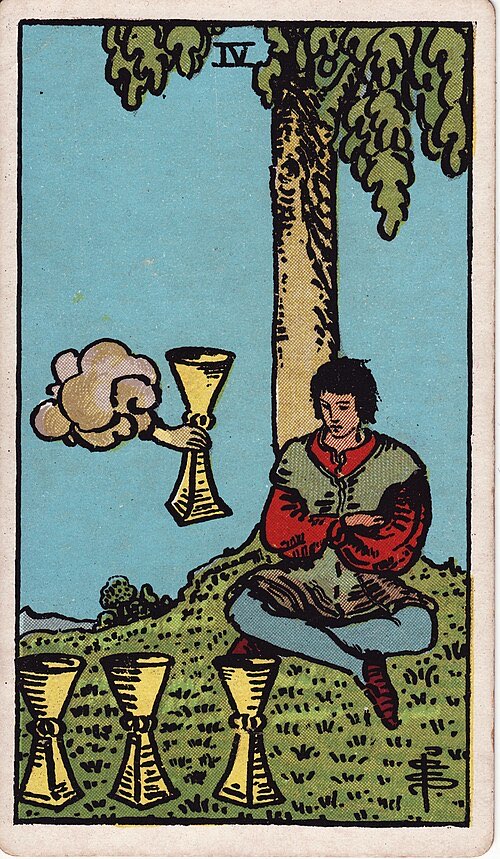
A young man sits under a tree with his arms crossed, staring down at three cups lined up in the grass before him. He has seen them already, and they no longer move him. He does not notice the fourth cup — a hand offers it from a small cloud at his elbow, exactly the gesture that gave him the Ace, and he is too sunk in his mood to look. Fours are the number of stability, and in Cups that stability has gone stale into a sulk.
This is the water gone still and a little stagnant. The excitement of the earlier cups has worn off; what was new is now merely present, and the heart has folded its arms. It is the most quietly honest card in the suit about a particular human failure: how a fixed mood can make us blind to what's being offered right now.
Upright
A gift is being held out and you're not seeing it. Discontent, boredom, the flat grey feeling that nothing on offer is quite worth reaching for — and meanwhile a full cup waits at your elbow, unnoticed. The Four is a state of emotional withdrawal: you've turned inward to brood over what you have and found it wanting, and the turning-in has become a wall. Sometimes the contemplation is needed — real reevaluation, a fair look at what no longer satisfies. But watch the tipping point where reflection becomes refusal, where the sulk itself is the problem. The card's quiet instruction is simple: look up. Something good is right there, and it won't be offered forever.
Reversed
The apathy lifts. Reversed, the Four is the moment you finally raise your eyes — the fog of discontent clearing, appetite for life returning, a new willingness to accept what's on offer instead of dismissing it. The crossed arms come open. You start to see the fourth cup that was there the whole time, and reach. It can also tip the other way into restlessness — pulling yourself out of a needed pause too soon, grabbing at anything to escape the stillness. Read the surrounding cards. But most often, reversed, this is grace: the end of the sulk, the choice to be interested in your own life again.
Across the four arenas
- Love — Taking a good bond for granted, or numb to affection that's genuinely there. Someone may be offering more than you're noticing. Look up from the boredom before you mistake contentment for a dead end.
- Work & wealth — Disenchanted with work that once excited you, blind to an opportunity at your elbow. Before you conclude nothing's worth pursuing, check whether the fourth cup is an offer you keep declining out of habit.
- Body — Low energy, listlessness, the heaviness of a mood that won't move. The body asking for a shift you keep refusing. A walk, a change of scene — break the stillness before it sets.
- Mind — Rumination that's stopped being useful, going in circles over what dissatisfies. Contemplation is only worth it if it turns into a decision. Reevaluate, then act — don't just stew.
How Sage reads it
Don't read the Four of Cups as simple laziness. Its deeper current is the way a fixed emotional posture becomes a filter — how a heart set on dissatisfied will fail to register the very thing it's been asking for. The common misread is to treat the sulk as wisdom, the refusal as discernment. Sometimes it is; often it's just the water going stagnant. So Sage reads the Four as a gentle interruption: notice the mood you're in, and notice that a hand is holding something out. You don't have to take the fourth cup. But you do have to see it before you decide.
A cup is being offered at your elbow this week. Uncross your arms and look.