King of Swords
authority · intellectual power · truth · fair judgment
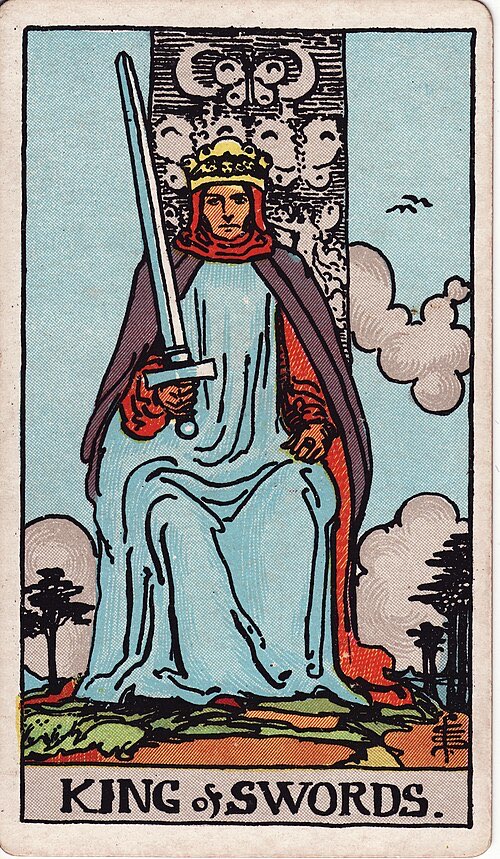
He sits facing forward on a stone throne carved with butterflies and a slice of crescent moon, sword held upright in his right hand, tilted just slightly — the posture of a judge who has heard the case. The sky above him is clear; the trees barely stir. Where the Knight charges and the Queen discerns, the King simply decides, and the world tends to arrange itself around his verdict.
This is Air mastered — the intellect matured all the way into authority. The King of Swords rules by thought: principle over impulse, truth over comfort, judgment that holds because it was reasoned rather than felt. His stillness is the tell. He is not in a hurry, because a clear mind rarely has to be.
Upright
He rules by clear thought and fair judgment. The King of Swords is intellectual authority at its best: decisive, principled, impartial, able to see the whole board and rule on it without letting bias or feeling bend the verdict. Make the decision. Stand by it. Be the mind the situation needs. This is the counsel of the strategist, the judge, the leader who says the hard true thing and holds the line under pressure. Lead with reason, communicate with precision, and let your standards be visible and consistent. The King's power is that people trust his judgment — because it's fair, because it's clear, and because he applies the same blade to himself that he applies to everyone else.
Reversed
Authority severed from heart. Reversed, the King of Swords is intellect without warmth — cold logic that has forgotten there are people inside the decisions, rules enforced without mercy, a mind so committed to being right it stops being kind. At its worst it's power used to wound: the sharp intelligence turned into control, manipulation, or contempt for anyone who reasons differently. It can also be judgment gone rigid — unable to bend, tyrannical about its own correctness. Reversed asks you to check the blade: is your clarity serving what's true and fair, or just your need to dominate? Authority without compassion is only force wearing a crown.
Across the four arenas
- Love — Honesty, principle, and clear communication in a bond — or the risk of ruling the relationship like a courtroom. Bring the fairness; leave the verdicts at the door. Love needs a listener, not only a judge.
- Work & wealth — Time for sound strategy and firm, fair decisions. Lead with reason, set clear terms, hold your standard under pressure. The authority here is earned by consistency, not asserted by title.
- Body — A disciplined, rational approach — the plan followed, the standard held, the decision made and kept. Just don't let the rigour turn punitive. The body responds to fair governance, not tyranny.
- Mind — The native arena. The mind at full authority — clear, principled, decisive, master of its own reasoning. At its peak when the sharp judgment is paired with the humility to be corrected.
How Sage reads it
Don't read the King of Swords as merely "a powerful, smart man" — his deeper current is judgment held in service of truth rather than ego. The card's shadow is unmistakable: the same mastery that makes him fair can make him cold, and intellect without heart becomes a weapon pointed at everyone who thinks differently. So Sage reads the King as a standard to grow toward and a warning to heed. Be the clear, decisive mind the moment needs — make the call, stand by it, lead with reason. And keep the crescent moon on the throne: the reminder that even the sharpest judgment owes something to mercy.
Be the clear mind the moment needs — decide, and stand by it. Just keep mercy on the throne beside the verdict.