Knight of Cups
romance · charm · idealism · invitation
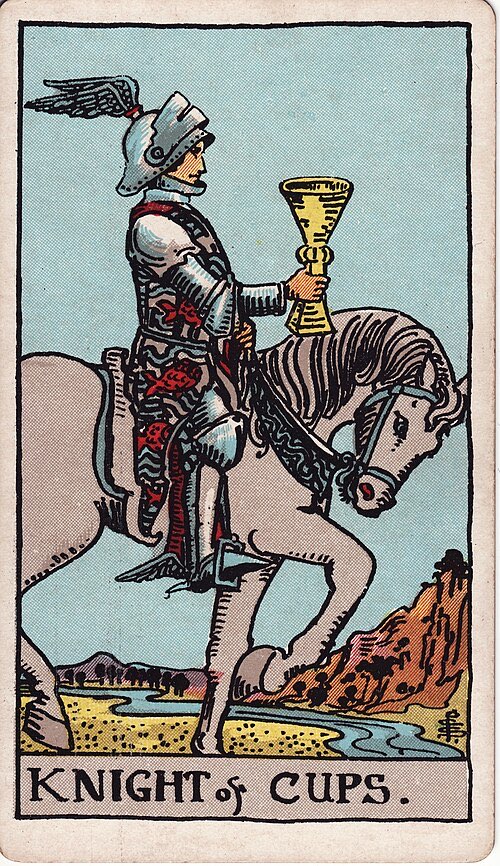
A knight rides forward at a walk, not a charge — his horse stepping calmly, his armor winged at the helm and heels. He holds a single cup out before him like an offering, and his eyes are on it, dreamy and sincere. A river winds through the green hills he's crossing toward. This is Water on the move: feeling given direction, a heart carried forward and extended toward someone.
Every Knight is the suit's element in pursuit of something, and the Knight of Cups pursues love, beauty, the ideal. He is the romantic, the artist, the one who arrives with his heart already in his hand. Where the Knight of Wands charges and the Knight of Swords slashes, this one courts — gently, gracefully, sometimes too much in love with the dream to notice the ground.
Upright
The romantic arrives with an offering. A proposal, an invitation, a heart extended toward you — the Knight of Cups brings the grand gesture, the poem, the door held open, the feeling declared out loud. Receive it with grace. This is charm in its sincere form: emotion in motion, imagination pressed into action, the willingness to lead with the heart and risk being moved. As energy in yourself, he's the pull to pursue what you love beautifully — to make the art, send the message, follow the feeling with style. Idealism is his engine, and at its best it lifts everyone it touches. Let the romance in. Just keep one eye on whether the offering has follow- through behind it, because this Knight's charm can outrun his staying power.
Reversed
The charm floats free of substance. Reversed, the Knight of Cups is the seducer who means it in the moment and forgets it by morning — sweet talk without follow-through, the grand gesture that never becomes commitment, the idealist so in love with the fantasy that reality can never measure up. He can be moody, manipulative, all feeling and no reliability. Or the withholding runs the other way: you're the one sitting on an offer you meant to make, keeping your heart in its cup out of fear. The card asks for honesty about the gap between word and deed. If someone's charm isn't backed by action, don't fall for the packaging. And if the one withholding is you — extend the cup you keep almost extending.
Across the four arenas
- Love — A suitor, a romantic overture, an invitation to something tender — or the call to pursue love with grace yourself. Enjoy the courtship, and watch that the sweetness comes with substance behind it.
- Work & wealth — A creative or heartfelt proposal, an alluring offer, work pursued for love not just money. Follow the beautiful idea — but ground the romance in a plan, or it stays a lovely pitch that never ships.
- Body — Grace, sensuality, movement with feeling — dance, flow, the body as an instrument of beauty. Move like you mean it. Just don't let idealizing the body replace inhabiting it.
- Mind — Imagination in service of a vision, the poet's mind, thinking led by feeling. Beautiful for creating; treacherous for deciding. Let the ideal inspire the plan, not replace it.
How Sage reads it
Don't reduce the Knight of Cups to "a lover on a white horse." Its deeper current is about the marriage of feeling and action — and the specific risk of a heart that's fluent in gesture but shy on follow-through. The common misread is to take the charm at face value, in others or in yourself. The Knight's gift is real: to lead with the heart, to make life more beautiful, to actually extend the cup. His shadow is all offering and no delivery. So Sage reads him as an invitation with a condition: pursue love and beauty with grace — and back the gesture with the deed, or you're just a pretty rider who never gets off the horse.
An offering is being carried toward you this week. Receive it with grace — and check it has legs.