The Hierophant
tradition · mentorship · belief · teaching
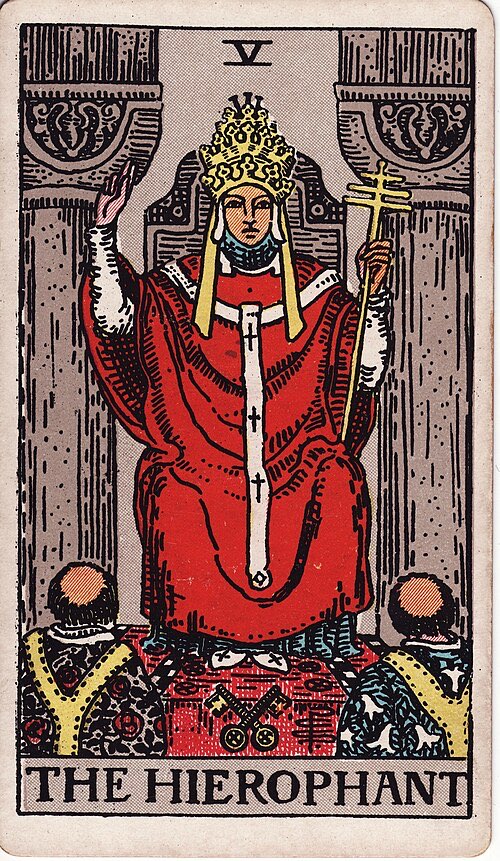
He sits between two stone pillars, robed in red, one hand raised in blessing, a triple cross in the other. Two acolytes kneel before him with their backs to us, receiving what he transmits. At his feet lie the crossed keys — the keys to a door you cannot pick, only be handed. He is the keeper of the received tradition, the one who stands in a line of teachers stretching back further than anyone alive can remember.
The Emperor built the outer structure; the Hierophant guards the inner one — the doctrine, the ritual, the accumulated knowing that no single lifetime could reinvent from scratch. Where the High Priestess held the mystery in silence, the Hierophant is the mystery made teachable, passed down through form.
Upright
Ancient knowledge is offering itself to you — through a mentor, a lineage, a proven path someone else already walked and mapped. The Hierophant's counsel runs against the modern instinct to figure everything out alone: honor what came before. There is a door here you cannot pick, only be handed the keys to, and the handing requires you to sit down and be a student. Apprenticeship is not weakness. Following an established method before you innovate is not a failure of originality — it's how originality earns the right to break the rules. Some things genuinely cannot be self-taught. This is the season to find the one who can teach them.
Reversed
The inherited path stopped fitting, and you can feel it. Reversed, the Hierophant is the moment the doctrine you were handed no longer matches your lived experience — and the honest move is to question it, even when the dogma is your own. This is the rebel's card as much as the priest's: breaking from convention that has outlived its use, refusing an authority that was never accountable. But watch the opposite ditch — rebellion for its own sake, throwing out real wisdom just because it came with a robe. The keys don't stop being keys because the priest got pompous.
Across the four arenas
- Love — Commitment, ritual, and shared values deepen the bond. Ceremony matters here — it marks what matters. The vows, the traditions, the agreed-upon meaning between two people are load-bearing, not decorative.
- Work & wealth — Follow the proven system before you try to beat it. Find the mentor, study the canon of your field, learn the craft the way it was handed down. The Hierophant rewards the apprentice, then promotes the one who mastered the form.
- Body — Work with a coach, a trainer, a doctor — someone with earned expertise to guide you. Your body benefits from transmitted knowledge now, not improvised protocols from a stranger's video.
- Mind — Formal study, structured learning, the lineage and the reading list. This is the PhD, the canon, the tradition you enter rather than invent. Go deep into what's already been thought before you rush to add to it.
How Sage reads it
The common misread is that the Hierophant is anti-individual — a card of conformity, of bowing to institutions. He isn't. He represents the specific wisdom that only arrives through lineage and transmission, the things a single clever person cannot reason their way to alone. His shadow is where institutions usually rot: dogma valued over direct experience, the letter kept and the spirit lost, authority used to dodge personal accountability. Sage will name it the moment the tradition becomes a place to hide instead of a place to grow. But at his heart he is the teacher, the keeper of keys, the one who hands you what the ancestors paid to learn. When he appears, the question isn't whether to submit. It's what you're finally willing to be taught.
Learn from someone who's already walked where you're going this week.