Four of Swords
rest · recovery · stillness · retreat
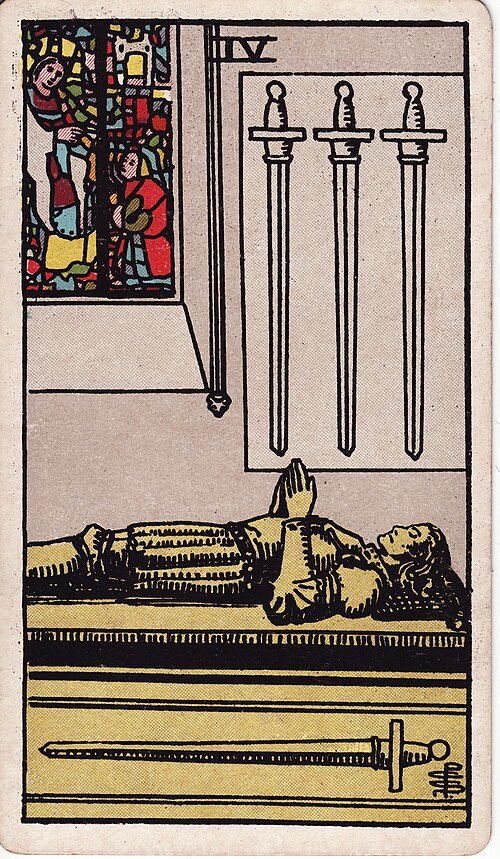
A knight lies carved in stone atop a tomb, hands pressed together as if in prayer. Three swords hang on the wall above him; a fourth rests along the side of the tomb beneath. Light falls through a stained-glass window. It looks like death, and it isn't — it's sleep, sanctuary, the deliberate laying-down of arms.
After the heartbreak of the Three, the mind demands stillness. The Four of Swords is the recovery room of the deck: the retreat you take not because you've quit, but because you cannot fight well from an empty tank. The swords are on the wall, not in hand. This is a pause, chosen.
Upright
Lay the swords down. You have been going hard — mentally, emotionally, or both — and the card is telling you, without apology, to stop and recover. Rest is not quitting. It is not weakness, not falling behind, not the enemy of progress; it is the part of the work that makes the rest of the work possible. The Four asks for genuine retreat: quiet the mind, close the door, let the body mend in the pause you keep refusing yourself. The fight will still be there. The difference is whether you return to it restored or ragged. Sharpen by resting the blade, not by swinging it duller.
Reversed
Two edges. Sometimes reversed means you're emerging — the rest is done, restlessness is stirring, and you're ready to pick the swords back up and re-enter the world. But more often it's a warning: you've pushed past the point where rest was optional and drove straight through it. Burnout, exhaustion, a body and mind demanding the pause you denied them. Reversed, the recovery is non-negotiable now — take it willingly or your system will take it for you, on worse terms. Stop before stopping is forced on you.
Across the four arenas
- Love — A relationship that needs space to breathe, or a pause after conflict rather than another round. Step back, cool down, let the silence heal rather than fester. Not every gap is a rupture.
- Work & wealth — Step away from the grind before it grinds you down. A strategic pause, a day off, a project shelved to recover. You'll make better moves rested than frantic.
- Body — The clearest arena. Sleep, convalescence, the body's plain demand for recovery. Honour it. This is the card of actually resting — not scrolling, not half-working, genuinely stopping.
- Mind — A mind that's been running too hot needs quiet. Meditation, a mental fast, an unplugged day. Stillness isn't emptiness; it's how thought settles clear again.
How Sage reads it
Don't read the Four of Swords as laziness or avoidance — that's the misread of a culture that treats stillness as failure. Its deeper current is that recovery is a phase of the work, not an interruption of it. The card's shadow is the opposite of retreat: the refusal to rest, the badge of exhaustion worn as virtue, the collapse you're courting by never stopping. So Sage reads the Four as permission you shouldn't need but do — lay the swords down. The knight isn't defeated on that tomb. He's gathering himself to rise.
Rest is not quitting — it's how the blade stays sharp. Lay the swords down before the tank runs dry.