Ten of Swords
ending · rock bottom · painful closure · sunrise coming
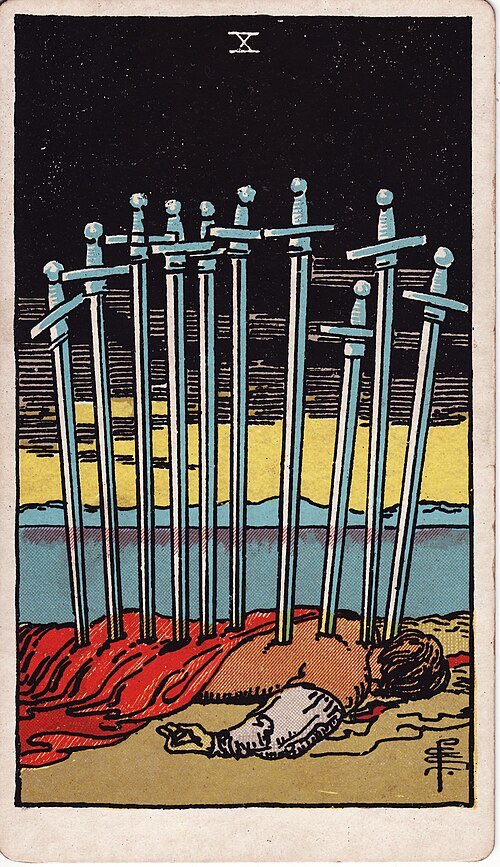
A figure lies face-down on the ground, ten swords driven into their back — every one of them, the whole suit spent at once. It is theatrical, almost absurd in its totality; no one needs ten swords to finish a job. But past the body, along the black horizon, a band of gold is breaking. The sun is rising over the worst moment of the story.
That dawn is the entire card. The Ten of Swords is rock bottom, and rock bottom has one strange mercy the middle never offered: there is no further down. When it cannot get worse, the only remaining direction is up.
Upright
The absolute ending. Something is over — decisively, painfully, all the way. A betrayal that landed in the back, a collapse you didn't stop, a chapter finished in the most final terms. The Ten of Swords doesn't soften it: this is the bottom. But it is also, precisely, the bottom — and the melodrama of ten swords is the card's dark wink, the suffering so complete it tips into release. It cannot get worse, which means the only direction is up. The sun is already rising behind you. Don't crawl back to what ended; it's done and dying it further won't revive it. Let it be finished. What's next begins in the light coming over that horizon — and it's coming.
Reversed
Rising from the floor. Reversed, the Ten is the aftermath — the worst genuinely over, the slow, shaky business of getting up. Survival, recovery, the first breath after the end. It carries relief and a kind of dark gratitude: you're still here, and the thing that finished can't finish you twice. There's a warning edge too — reversed can mean clinging to the drama of the collapse, refusing to let the ending end, resurrecting the pain because letting go feels like losing the story. Reversed asks you to stand up. The swords are out of your back now. Turn toward the sunrise and don't lie back down.
Across the four arenas
- Love — A relationship at its definitive end, or a betrayal that closed the door for good. It's over — and that finality, painful as it is, frees you from limbo. Grieve it, then let the dawn come.
- Work & wealth — A project, role, or venture that has collapsed completely. Rock bottom, and the strange clean slate it leaves. Nothing left to protect means everything left to rebuild. Start from zero.
- Body — Total depletion, the breaking point that forces a full stop and a full reset. The end of a way of living that couldn't continue. Rock bottom is where the rebuild finally becomes possible.
- Mind — The signature arena. A belief, an identity, or a story finished for good. The death of an old mental world — brutal, and the ground the new one grows from. Let the old script die.
How Sage reads it
Don't read the Ten of Swords as pure catastrophe — that misses the dawn the card so deliberately paints. Its deeper current is completion: the end that is total enough to finally be over, the bottom that becomes a floor to push off. The card's shadow is refusing that gift — staying in the grave, re-stabbing yourself with the memory, treating a finished thing as an open wound. So Sage reads the Ten with an unexpected steadiness: yes, this is the worst of it, and yes, it is the last of it. The sun is rising over the horizon. The only honest response is to get up and walk toward it.
This is the bottom — which means it's also the turn. The sun is rising behind you; get up and walk into it.