The Chariot
willpower · momentum · direction · victory
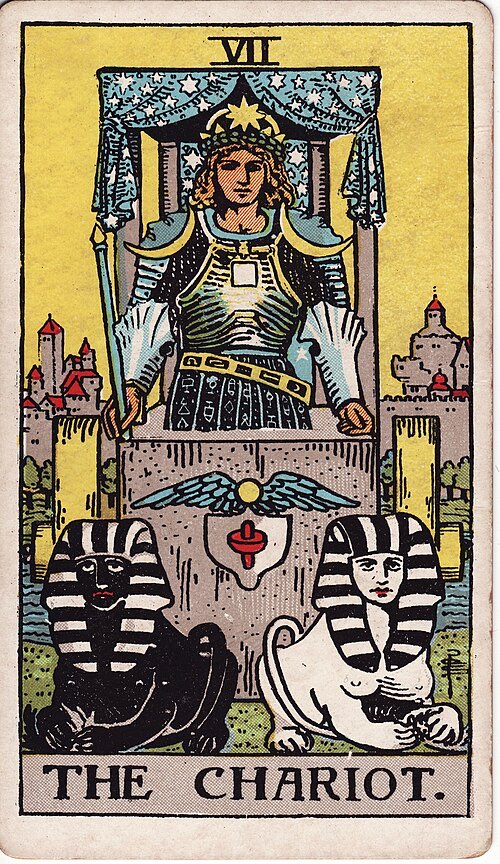
A charioteer stands armored in a chariot drawn by two sphinxes — one black, one white — and here is the detail that unlocks the whole card: he holds no reins. The sphinxes pull in opposing directions, and he keeps them moving forward by will alone, by the force of his intention and the crown of stars on his head. Behind him, a walled city he has already left. He is motion mastered — not the absence of conflict, but conflict harnessed and pointed at a horizon.
The Lovers made a choice; the Chariot is the drive that carries the choice through the world's resistance. Number seven is the will that has stopped deliberating and started moving, opposing forces yoked to a single direction.
Upright
Grip the reins — or rather, do what the charioteer does and hold the horses by intention alone. You are the force moving this forward, and the moment calls for determined, directed will: eyes on the goal, distractions cut, momentum protected. This is victory through discipline, the win that goes to whoever refuses to stop. But read the image closely, because its lesson is subtle. The two sphinxes want to pull you apart. Mastery here is not eliminating the tension between your competing drives — it's holding it, keeping both in harness, and moving anyway. Don't stop now. The forward motion is what turns the conflict into progress.
Reversed
The horses are pulling in different directions and the chariot is starting to tip. Reversed, the Chariot is direction lost — full force applied down the wrong road, or aggression that's actively undermining the thing it means to win. Sometimes it's scattered focus, fighting yourself instead of moving; sometimes it's burnout from pushing so hard the engine seized; sometimes it's pure inertia, the chariot stalled while you insist you're about to go. The fix isn't more force. It's alignment. Get the opposing pulls pointed the same way before you drive, or you'll spend your will spinning in place.
Across the four arenas
- Love — Moving forward through a challenge in the bond — holding your ground with compassion rather than retreating or steamrolling. The Chariot in love keeps its direction without turning the other person into an obstacle to be defeated.
- Work & wealth — Determined forward motion toward a goal, success earned through directed will. You've got momentum and the road is clear enough — this is not the moment to coast or second-guess. Drive.
- Body — Athletic peak, physical determination, the will to push through resistance. The body answers to command right now. Just watch the reversed edge — overexertion and burnout live one gear past mastery.
- Mind — Focused determination. Cut the distractions and the mind goes where you point it. This is single-minded concentration in service of a goal, not scattered brilliance — pick the direction and commit the whole engine to it.
How Sage reads it
The common misread is that the Chariot is about brute force — willpower as a battering ram. Look again at the sphinxes. They pull in opposite directions, and the charioteer isn't fighting to make them agree; he's mastering the fact that they never will. That's the teaching: victory here is holding the tension between your own opposing forces and moving forward through it, not resolving the tension into some tidy sameness. Its shadow is willpower used to suppress feeling rather than integrate it — the win purchased at the cost of the soul, the person who conquered everything and feels nothing. Sage will name it when the drive starts steamrolling the inner life it was supposed to serve. But at its heart this is Arjuna in the chariot, mastery achieved through inner conflict harnessed into direction. When the Chariot appears, don't ask how hard to push. Ask what your two horses actually want, and whether you've pointed them at the same horizon.
Hold the reins without pulling them this week — move forward through integrated tension, not brute force.