The Emperor
authority · structure · discipline · leadership
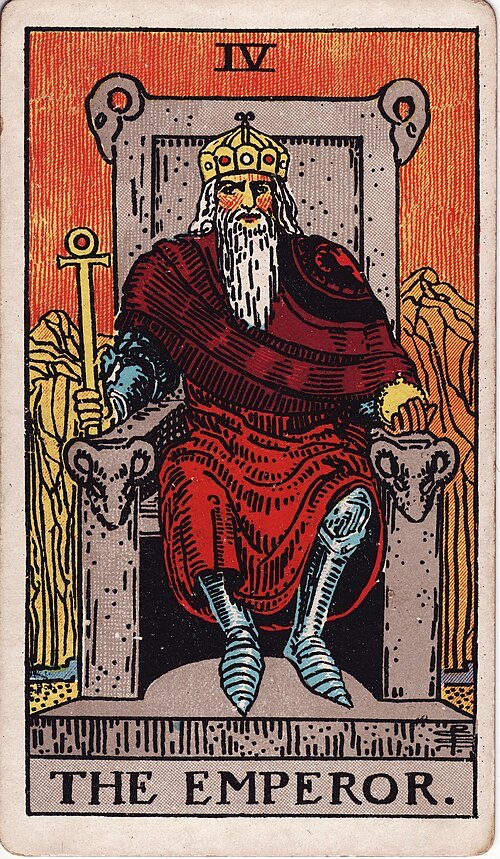
He sits on a throne of grey stone carved with rams' heads, and behind him rise bare mountains — no soft field here, no running stream. His armor shows beneath his robe: even at rest, even crowned, he is ready. He holds an ankh in one hand and an orb in the other, life and dominion. He does not lean back. The Emperor's whole body says the same thing his empire does — this will hold.
If the Empress is the fertile field, the Emperor is the wall around it. Number four is the square, the table with four legs, the first structure stable enough to build on. He is what love needs to survive contact with the world: form, boundary, a steady hand that doesn't flinch.
Upright
Build the structure. Set the rules. Claim the throne — not as a power grab but as the plain assumption of responsibility the situation has been waiting for someone to take. This is the season for architecture, not improvisation: the systems, the boundaries, the routines that produce a result you can count on tomorrow and the day after. The Emperor's gift is the least romantic and most reliable one in the deck — discipline applied consistently until chaos has a shape. Where the field was running wild, you put up fences. Where everyone was waiting, you decide. Stability isn't the enemy of freedom. It's the container freedom needs to grow inside of.
Reversed
The structure has turned against its own purpose. Reversed, the Emperor is control hardened into rigidity — rules kept long after they stopped serving, a grip so tight nothing new can breathe, dominance mistaken for strength. Or the throne sits empty: discipline abandoned, no routine, no follow-through, authority handed to someone who never earned it. The tell is domination where dominion was called for — force used because trust felt too risky. Ask the blunt question the card is asking: who is actually in charge here — and is it steadiness on that throne, or fear wearing a crown?
Across the four arenas
- Love — Show up as a reliable, boundaried presence — the one whose word holds. The Emperor in love is protective, not controlling; the difference is whether your structure gives the other person ground to stand on or a box to live in.
- Work & wealth — Build the systems and boundaries that produce consistent results. This is not the hour for a burst of inspiration — it's the hour for architecture, the unglamorous scaffolding that lets everything else stop depending on your mood.
- Body — The body answers to structure. A training schedule actually followed, a rhythm you keep whether or not you feel like it. Watch the two edges: over-rigid control on one side, no routine at all on the other. Aim for the steady middle.
- Mind — Systematic study, organized thinking, a plan with a spine. The Emperor mind builds frameworks and works inside them — just keep a door open, so the framework stays a tool and never becomes a wall against new information.
How Sage reads it
People flinch at the Emperor, reading him as aggression, patriarchy, the boot. He isn't that. He's the builder of stable structures that protect what matters — the father in the best sense, the one who makes a place safe enough for softer things to live in it. His shadow is real and worth watching: rigidity that can't bend, control offered as a cheap substitute for trust, domination where true authority would have been enough. Sage will name it when the armor stops protecting and starts imprisoning. But at his core he is order drawn out of chaos, Zeus with a builder's patience. When the Emperor appears, he isn't telling you to conquer. He's asking what you'd finally commit to building if you trusted your own steady hand.
Build the container this week — the structure that lets everything else grow.