Seven of Swords
strategy · deception · cunning · stealth
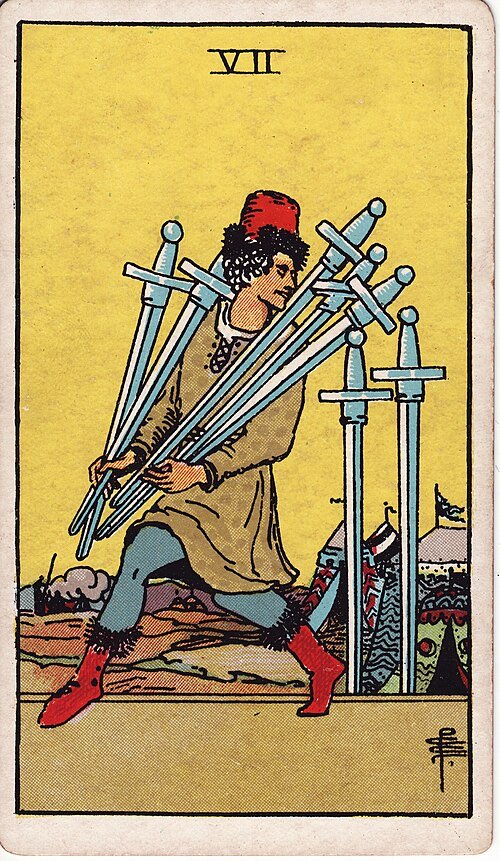
A man tiptoes away from a camp of tents, five swords bundled awkwardly in his arms, glancing back over his shoulder with a sly half-grin. Two swords stay stuck in the ground behind him — he couldn't carry them all. He's getting away with something, and he knows it.
This is the deck's trickster: cleverness, stealth, the plan executed in the dark. Sometimes that's genuine strategy — the smart, quiet move that wins by not being seen. And sometimes it's a con, dressed up as strategy so the one running it doesn't have to call it what it is. The Seven of Swords lives on exactly that ambiguity.
Upright
A strategic move, or a sly one — and the whole card turns on being honest about which. There's real intelligence here: acting alone, keeping your cards close, taking the clever route around a wall instead of through it. Used well, it's cunning in service of a good end. But the Seven's shadow is never far — the shortcut that shades into cheating, the omission that's really a lie, the plan that only works if nobody looks too closely. Ask yourself plainly what you're doing. If you're sneaking past yourself — hiding the move from your own conscience — that's the real con, and it's the one that costs you. Be shrewd. Don't be slippery.
Reversed
A lie coming to light — yours or someone else's. Reversed, the Seven is the moment the hidden thing surfaces: the deception exposed, the shortcut caught, the truth you buried clawing its way up. It can also be a conscience finally refusing the con — the impulse to come clean, to return the swords, to stop running the angle that's been eating at you. Either way the stealth is over. Reversed asks for honesty, sometimes the confessional kind. Come clean. The relief of being straight is worth more than whatever the trick was protecting.
Across the four arenas
- Love — Something withheld — a half-truth, a secret, a move made behind the other's back. Or a nagging sense you're not getting the whole story. Bring it into the light before it rots the trust.
- Work & wealth — Strategy that works best unannounced, or a corner cut that could catch up with you. Be clever, stay clean. The move that only survives if nobody checks isn't a strategy, it's exposure.
- Body — Cutting corners with yourself — the skipped habit hidden even from you, the "just this once" that's become a pattern. The body keeps the honest ledger. Stop running the con on your own health.
- Mind — The signature arena. Self-deception, the stories you tell to make the shortcut feel principled. Sharper thinking starts by catching yourself in your own spin.
How Sage reads it
Don't read the Seven of Swords as simply "a liar nearby" or simply "be clever." Its deeper current is self-honesty — the difference between a strategy you'd defend in daylight and a con you're keeping in the dark, even from yourself. The card's shadow is the sly grin over the shoulder: getting away with it, and slowly becoming the kind of person who has to. So Sage reads the Seven as a mirror, not an accusation. Be cunning where cunning is clean. But name the move honestly first — because the person you can never actually sneak past is you.
Cleverness is only strategy if you'd defend it in daylight. Don't sneak past yourself — that's the real con.